


Menstrual Cup Firmness: Measuring the Immeasurable
A definitive menstrual cup firmness chart is not possible due to how the thickness of silicone (which is technically measurable) is only part of how the cup’s firmness feels when worn. Shape, thickness, type of material, and more play a role in how firm or soft the cup wears while inside the vagina. Other design elements, such as internal support or varying thicknesses, can also have an effect on how the cup feels while worn.
All that said, we’ve done our best to group cups into five categories after the direct handling and comparison of each brand and size. There is a bit of variance in some of these cups (as noted below the graphic) but generally speaking the firmest or most prominent portion of the cup is what lands a cup in a category. For example, the LadyCup has a soft base but a thick and firm rim. Because the firm rim is what will apply the most pressure, we rank it as a firmer cup.
As we mentioned, material plays a role. Both silicone and TPU come in a variety of firmnesses. TPU does mold to your body more with heat, which also has an effect on how the cup feels when worn. The Keeper is made from natural rubber and is by far the most firm cup on this list (it’s actually quite hard).
Menstrual Cup Firmness Guide
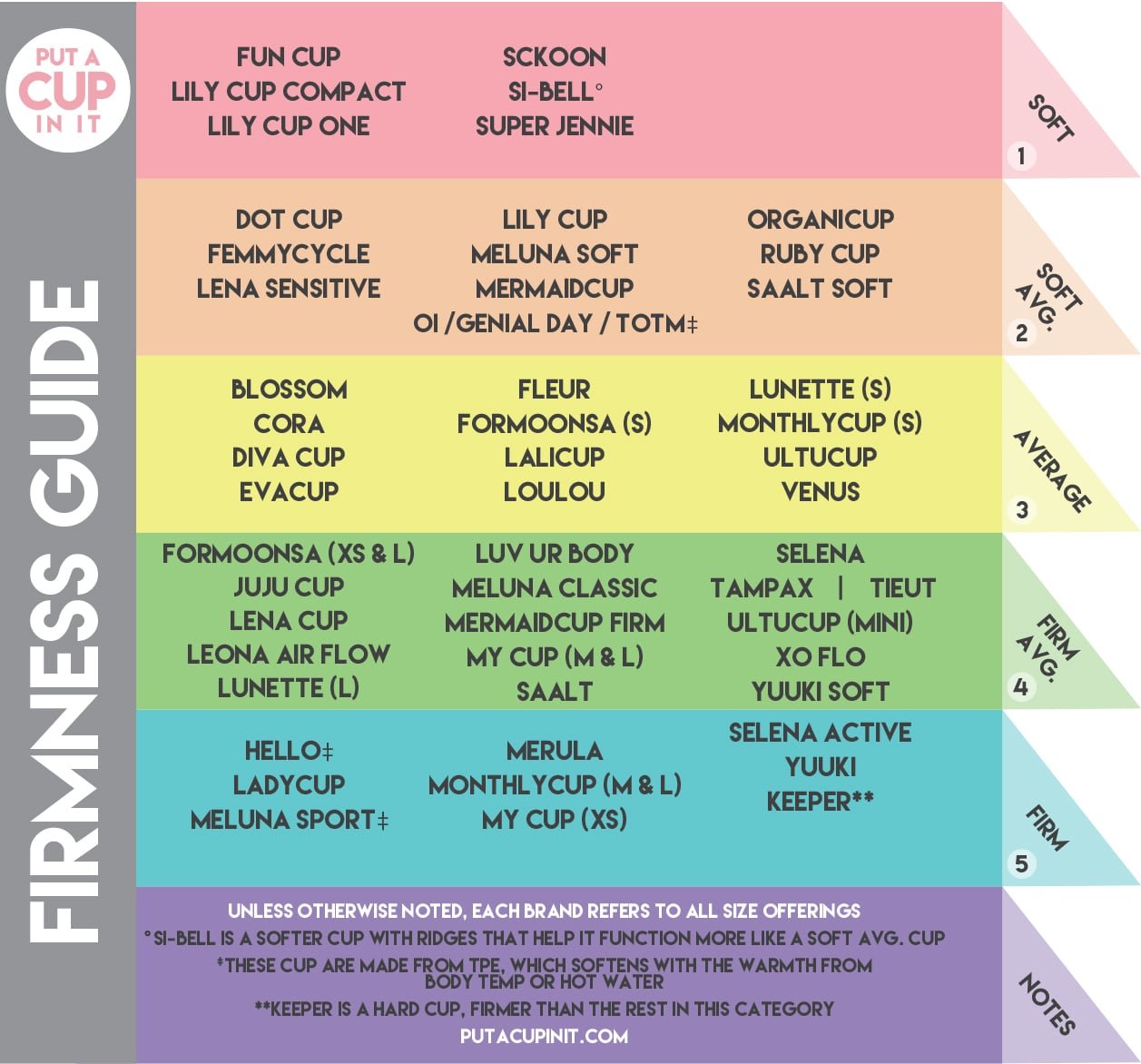
Cups with varying thickness/firmness include:
- LadyCup — base is average firmness while the rim is firm
- Lily Cup — this cup has a soft body but firm, non-protruding rim & internal spine to help it open
- Merula — rim is non-protruding average firmness while the body has a firmer feel due to the bulbous shape
Why does firmness matter?
Choosing a cup with the correct firmness for your body can make a huge difference in your comfort and the effectiveness of the cup. In general, softer cups are more comfortable because they don’t apply any outward pressure but they can be harder to get open inside. We call softer cups “fiddle cups” because there is often some manual maneuvering that has to be done in order to get the cup to open once inside. Soft average cups will be slightly better when it comes to opening and still offer a high level of comfort.
Average or average firm cups are better when you first begin using a cup because they take little to no coaxing or manipulation to open once inside. Average firm cups may apply some slight pressure that only announces itself once you try to urinate, making your urine stream a tad slower (see our post and video: Peeing with a Menstrual Cup). Firm cups may apply noticeable pressure that shows in either an urge to urinate (bladder pressure) or slow urine stream. In severe cases a complete blockage of urine could occur, though this is very rare. While the pressure mentioned is a possibility it isn’t a guarantee, we just feel pointing out all possibilities is important. On the plus side, average firm, and firm cups are better for those who experience cups that slip down during wear. If you’re a very active person you will want an average firm or firm cup to prevent your muscles from pushing the cup out during exercise.
To find more information on the brands listed in the firmness guide you can visit our menstrual cup comparison chart– this sortable chart lists details such as capacity, length, diameter, and more.
Did you find this post helpful? Please share your thoughts in the comments!






77 Responses
I’ve used a Yuuki Classic 2 for 5 years, I wanted to try a different cup because I loved my Yuuki but it was hard to even pee with it inside.
I tried LadyCup and it’s too soft for me (I guess I have quite a strong pelvic muscle), I bought the Yuuki Soft and same issue, it doesn’t open and it’s just too soft for me.
Is there a cup which is almost as firm as the Yuuki Classic but a little bit softer?
Are there any softer cups than Lily Cup One out there? Lily Cup One is my first cup, and I’ve been using this one for almost two years now, it works well overall, but I can always feel the rim.
I’m a trans guy, and biggest appeal of cups for me was that you apparently don’t feel them and forget you’re even wearing one, but that wasn’t the case for me unfortunately.
If you’re noticing the rim, it could just be the shape of the cup. It’s pretty soft but it does have a very triangular shape. Something with a less pronounced rim (in comparison to the body) might be more comfortable
I used a Diva Cup for years, but post child birth, it feels very uncomfortable with a lot of pressure. When I took the quiz, it recommended an even firmer cup, which doesn’t make sense to me. Any recommendations on how to move forward?
Hello! How do you determine the firmness of the cup? Do you have any criteria that determines what number it gets?
would a firmer or softer cup be better for someone who experiences leaking as a result of strong pelvic muscles causing creasing
I ordered Organicup, it took almost a month to arrive Canada. I liked the packaging but it’s my second cycle, I want to keep using it but I have huge leaks even though it’s not full. I tried different inserting techniques, still leaks. Also I am having little bit hard time to remove it. I can only reach the stem and doesn’t come up easily. Should I give a try another cup? I tried the quiz and suggested Lunette. Thank you!
I have the same issue with all OrganiCups, I’m thinking of buying a firmer cup