


We feel that it’s time to address the big, cheap elephant in the room — “generic” menstrual cups and disc.
Cheap menstrual cups are usually referred to in cup communities as “cheapies” or “knock-offs” these cups are priced as low as $2 on eBay or in apps — some are even sold “free for shipping” like in a viral Facebook promotions. Considering reputable brands, like The Diva Cup, a brand sold in stores across the US and Canada, retails for $40 these cups seem like QUITE a deal.
How do we define what a “generic” or cheap menstrual cup or disc is?
By our definition a cup is considered a “generic” or “cheap” cup if it does not have a unique, proprietary design and/or is not known to be made from FDA cleared silicone, TPE, or rubber. Generic cups will often be the same design sold under many name brands with varying packaging or without any brand name at all, only a listing description. While not inherently a safety issue, it does pose and ethical problem in regards to intellectual property and integrity.
By contrast, brand name cups are unique in their design, packaging, marketing, and online presence. We list only known and trusted brands on resources like our quiz and comparison chart. If you’re looking for a cup and don’t see it listed, it’s likely considered generic.
How do I know if a cup is “real” or “generic?”
Below is a list of tell-tale signs a cup is not a reputable brand and may want be avoided.
- It’s not listed as FDA, BfR, or EC compliant. Unless not sold in the US & compliant with international standards, we suggest avoiding all brands without the FDA designation.
- The cup is sold via:
- Wish App
- Alibaba or AliExpress
- Co-Ops
- eBay
- Amazon only (not also sold through retailers or a branded website)
- Wal-Mart (brands sold though website and not fulfilled by Wal-Mart)
- The cup’s price is $15 or less
- The cup lists a high price ($29.99-39.99) but is always marked down well over 50% off.
- The brand cannot be found online elsewhere (such as their own website, other stores, or on social media).
- The product description has typos and errors in grammar.
- The cup ships directly from China.
- The cup has minimal packaging in photos (only a plastic bag, only a pouch, etc)
- The cup has no name at all and is only listed as a nonsensical string of keywords “ladies vagina period reusable copa menstrual cup hygiene wow”
- The cup’s listing title uses “Diva Cup” or “Moon Cup” but is not that brand.
- The listing makes hard to verify claims “Voted Better than Diva,” or “Best selling” without proof or award seals.
- The cup looks identical to several other cups but has a different name.
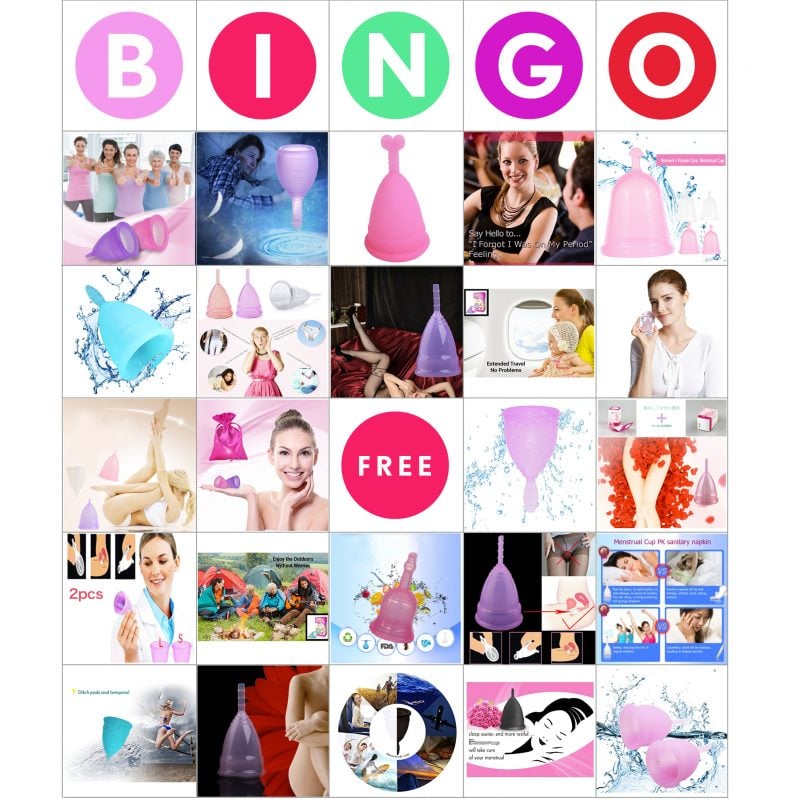
- The cup listing has weird ass stock photos and god awful graphics.
Brands We Avoid
Based on our experience and knowledge of cup brands we do not advocate the use of products by the following brands:
- Alilove, AMAZZANG, Aneer, AneerCare, Anytime, Athena, Bodybay, Calicup, CHUDONG, Coomammy, Daisy Cup, Dandelion, Day and Night, Dewcare, Dew Fresh, Diggold, Dovewill, Easymoon, Ecosin, Fairyfox, Fivebop, GIMITSUI, GUAnqqi, HENGSONG, iCare, Intimate Rose, JACKYLED, Jubilene, June Cup, kesoto, Leasen, Leegoal, Luna, MagiDeal, Miusie, Monzcare R-Cup, Nezbling, OTTBA, Ovu, Pixie, Protable, Rebel Kate’s unnamed cup, RedDhong, Remedy Health, Shelcup, Sileu, Skinco, Smart Cup, SPEQUIX, The Goddess Cup, ThinkMax, TOOGOO, Viva Cup, WensLTD, Yamete, Yiwa.
- Xi’an Furuize Biotechnology Co – Some brands utilizing this manufacturer may appear above. They produce a wide range of cup models that are sold and marketed under dozens of brand names. June Cup is a recent brand that utilizes this manufacturer and exploded onto the market (and into our DMs). While this manufacturer is registered with the FDA, a quick look at their cup models shows intellectual property concerns, which are compounded the fact that many of the brands who sell their products do not have a presence outside of Amazon and have little to no customer support or education. Additionally, the opportunistic and erratic pricing of these cups makes for an increasingly confusing marketplace and unpredictable customer experience.

What’s the deal with FDA clearance?
FDA cleared brands have passed manufacturing standards that meet strict medical guidelines. While the thought of our periods being regulated like illnesses gives us feelings, we appreciate the assurances of safety when it comes to a cup that will reside in your vagina.
Generic brands often use false claims of “FDA cleared silicone” because they know that informed consumers want safe products. Unfortunately anyone can say anything they want on the internet and Amazon has a lackluster history of ensuring accurate listings and enforcing protections of intellectual property.
First and foremost — be an informed consumer. We can’t say it enough. This is an internal device and you want to be sure that the product you use is in-fact medical grade silicone and that it does not contain potentially unsafe colorants or contaminants.
Research the brand you are interested in, cross reference with the FDA cleared list, and ask for proof if you can find a contact email — but know that anyone can SAY they have certifications and tests when they know 99% of buyers will never fact check them or have no way to. Some of the unnamed brands have claimed they are made by FDA cleared companies listed on the FDA website but there is no way to know for sure since the brand itself isn’t listed. Only brands with their names listed can prove their compliance — and your safety.
Why should I care about intellectual property?
As mentioned, many cheap brands are simply knock-offs of reputable brands who have put their hearts, time, and money into the creation of their products and designs. While some of these brands may be FDA cleared, we still feel strongly against supporting these brands and do not include them in our resources. These brands hurt by having their property stolen both emotionally and tangibly as many consumers aren’t aware of these facts and opt for what is most wallet friendly – even if the knock-off is just a few dollars cheaper. This does obvious harm to the established brands and in many cases also harms the consumer. Most knock-off brands come with little or no customer service – leaving new cup users with little assurance if they have purchased the wrong size or run into other troubleshooting issues that reputable brands are known for helping with.
So, should you buy a generic menstrual cup or disc? And if you DO buy one will it work?
Put A Cup In It has the official stance that we do not support the purchase of ANY “generic” brands for a few reasons.
- Most do not use FDA cleared medical grade silicone, so it’s unclear what is being put inside of your vagina.
- Most do not have official websites or customer support. If you don’t receive the product or if the product fails you have no recourse.
- Most are stealing designs of other brands and undercutting them on price – typically while not delivering the level of quality silicone and service brand names provide.
- Inconsistent products. While many of these cups may look alike, the firmness and quality of the silicone may vary.
Ultimately, if you feel confident that the product is safe to use, or are willing to assume the risk, the decision is yours. Our goal here is to help you make an informed decision regarding the use of a product that is worn internally and is regulated by the FDA.
But what do consumers think?
We decided to poll our own Facebook group, also titled Put A Cup In It, about their experiences with these “generic” menstrual cups. Results are as follows:
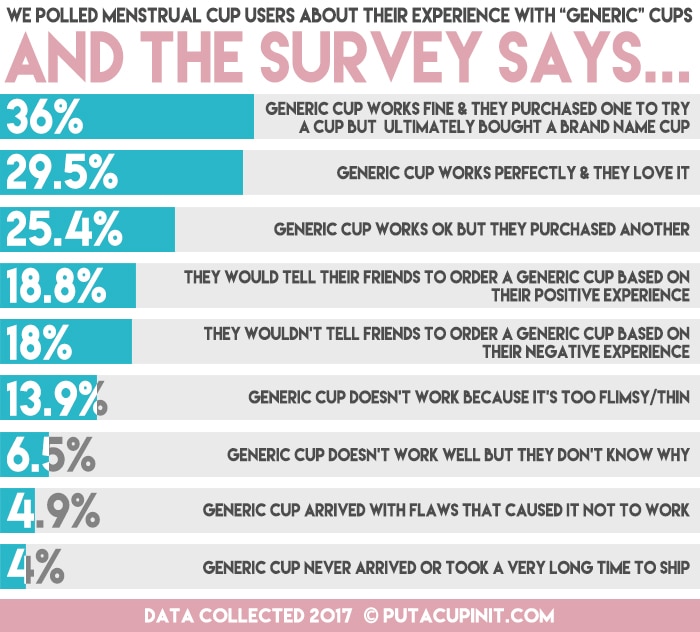
Of course our group is not a large enough sample to have a complete representation of all experiences with generic cups versus brand name cups, but it does give us some idea of why people buy them (the most selected answer shows that they purchase generics to test cups before investing in more expensive cups) and how they work.
Complaints against the cups included the products being flimsy, having rough seams, obnoxious chemical smells, and some even reported headaches caused by using the cup.
On the approvals side, there were two “generic” models that seemed to have the best reviews — Blossom Cup and Anytime. Again, we are not promoting the use or purchase of any generics but if you are buying then these are ones other people have had positive experiences with. Anytime is a knock-off of the FDA cleared brand name cup Sckoon (so on principle it’s not a cup we think people should support). As for Blossom, it is listed on the FDA website but in most other ways appears to be a generic. It is a budget friendly cup, however, and has good reviews.
As previously mentioned, whether the cup works or not the most important reason NOT to buy a generic cup is that it’s likely not made from FDA cleared medical grade silicone and thus not proven safe to wear inside of your body where heat and fluids are a factor. As a reminder, you can see the list on the official FDA government website here: Menstrual Cups with FDA clearance.
Why should you skip the cheap menstrual cup and start with a brand name menstrual cup?
Experience — The experience you have with your “throwaway” cup is more likely to be a frustrating one. Since so many people buy a generic cup to experience what using a cup is like as a whole it might turn you away from using ANY cup if the one you try won’t open or has constant leaks. As a general rule, PACII points new cup users to ones that are average in firmness for this reason — too soft and the cup is harder to get open, thus resulting in leaks. Since the generic cups are usually flimsy it makes sense why people may never go on to buy a brand name version due to a poor experience. Additionally, brand name cups come with real humans who are passionate about making their product work for you to improve your life. If you have questions or issues with your cup they are often only an email or phone call away.
Safety — Not only can you be assured that the device intended for 10-12 hours of wear INSIDE YOUR VAGINA is FDA Cleared and SAFE but you can also be sure that if something goes wrong you can reach a human for help.
We’ve spoken to many employees from cup companies and they truly know their stuff; they’re there to help people who have unfortunate first experiences with their menstrual cups. They’ve walked many a caller through removing a cup that feels stuck or that is thought to be “lost.” They’ve also been known to send a replacement when a customer has ordered the wrong size. They’re real humans who care that the customer has a good experience and part of the higher price paid is that peace of mind.
“But I don’t want to waste $40 on a cup that doesn’t work for me.”
We hear you and we completely understand. Thankfully there are several trusted brands that retail for under $30, but we know that money doesn’t grow on trees and cups aren’t exactly a thing you can sell when it doesn’t work (actually, some people do but it may not be your thing).
That’s why Put A Cup In It has resources available to help confused minds choose the best menstrual cup for them. Our menstrual cup quiz has a very high success rate when it comes to matching up takers with the cup that ultimately works for them. Our menstrual cup comparison chart lets you go even deeper and compare cups both numerically based on measurements such as length, diameter, and capacity plus you can compare cups visually.
Additionally, we have created a closed Facebook group that gives you a safe place to ask sensitive questions about picking or using your menstrual cup. We strive to make everyone’s journey a successful one and also a safe one.
If you really must try a cup cheaply before making the more expensive leap it is possible to “try on” a cup by utilizing a Facebook cup BST or swap group.
“Okay, I hear you, but I still want one.” : List of Cheap Brands Available with Amazon (Prime)
As with anything menstrual health, we support your decision to use the period protection of your choice. Below is a list of some of the cheapest cups and cup combos that we could find. We have intentionally excluded brands that use predatory and/or deceptive practices in their marketing. All of the below brands are listed for $5.99 – 11.99 for TWO cups or discs (or a singular cup under $5.99) and are available with free shipping.
Cheap Menstrual Cups
- EcoBlossom (Same as June but in purple & pink)
- Talisi (This is the same cup as June but in pink & blue)
- Aneer (This is also the same cup as the June but in teal)
- Talisi (This cup is similar to the shape of the JimmyJane menstrual cup)
- Talisi (Same shape as the Blossom cup)
- Talisi (Same shape as the HoneyPot cup)
- CareCup (Similar design to Saalt)
- Leya (Same as June but solid color in green)
- Shordy (Same as June but solid color in blue, pink, and green)
- PopCup (Similar design to Lena)
- The Happy Cup
Keep in mind that the brands listed above may come and go, due to the nature of them sometimes being ghost brands. If you are unsure, do a quick search for “silicone menstrual cup” to find the best price for the design you’re looking for: or click here.
Cheap Menstrual Discs
- EcoBlossom
- EcoBlossom (This is the same disc as June disc but in purple & teal)
- EcoBlossom (Similar design to Hello)
- EcoBlossom (Similar design to Lumma)
- CareCup (This is the same disc as June disc but in purple & clear/white)
- Bibrad
Keep in mind that the brands listed above may come and go, due to the nature of them sometimes being ghost brands. If you are unsure, do a quick search for “silicone menstrual disc” to find the best price for the design you’re looking for: or click here.
Please know that the list above is not an endorsement. Recommendations for very affordable cups come up *a lot* and while we do not recommend or formally support these brands for a variety of reasons, we do support you and want to help you find the best pricing and not be taken advantage of.
Other resources on this topic: Menstrualcups.wordpress
What’s Your Experience?
Have you tried a generic cup? Please share your thoughts and experiences in the comments. It would help others if you include the name or source of the cup.






108 Responses
Exactly. Menstruation is not just a 1st world problem.
For those who can’t understand why the cheapies are so attractive, please realize not all cup users reside in western countries.
We live in Uganda, where $1 is 3600 Ugandan shillings. The average rural woman only makes about 4000 shillings per day. This does not mean our quality of life is bad, but that we have much less buying power.
I found some of the comments which talked about not understanding why people aren’t willing to pay more to be offensive and careless about the financial power of the rest of the world. Just because you live in a country where $15 is a “reasonable” investment does not mean it is true for every woman going through menstruation.
On top of that, I have American and Canadian friends who are working full time but only barely able to maintain their housing. Don’t make menstrual cup use become an upper class tool, please.
As for our organization, we are running a pilot programme in which 15 menstruating ladies have been given Ruby Cup to try for 2 years. We have come to the end of the 2 years, and are now confident in distributing a large number of cups to those in most need. The idea of paying anything more than a few dollars makes our plan impractical. I for one am grateful that there are some manufacturers who are selling “cheaply” or rather what I would call globally affordable.
I’m totally in this with you. Not all countries have access to the big brands. So the cheapies are our best option.
Ichode, thanks for sharing your perspective from Uganda. Buying power because of differences in currencies makes global shopping difficult. But, I hope that you will still be able to use the safety considerations that are mentioned in this article. Please remember that many of these Cup manufacturers care about menstrual politics and they know that Cups are often a good solution… I bet there is a Cup company who would partner with you to provide Cups at a deeply discounted price. Just ask! Also, this is the type of project that many US, Canadian, European ,etc women would donate to.
Ichode, I fully stand behind your comment. Some of us quite literally can’t afford $30-$40 on a cup even if it WILL last a long time. For some of us, spending that much on one item is almost financially impossible, or irresponsible.
I’m surprised how some people in these comments will argue over a difference of $10-20 over the lifetime of a cup, say ooohhhh 5-10 years?! Unreal how people just don’t think. You would pay at least $5-7 for a monthly supply of pads or tampons anyway – you’re recuperating your ‘investment’ in less than 6 months (in the vast majority of cases) yet you’re complaining that the owners of this site aren’t doing more research on the potential merits of ‘cheap cups’.
I agree with the principle here – I don’t want potentially unsafe, non FDA-compliant materials in my vagina (my vag has been victimized with enough chemicals from 30 years of menstrual products, it’s in detox mode right now); and I want to make sure the cup’s designers are fairly compensated for their work. I took the quiz, purchased 2 of the cups recommended, and I don’t need to worry about the safety of my choices. That peace of mind is definitely worth something, and I’m also happy to purchase directly from the companies who actually design the cups I use (one in my home state! and one in Slovenia)
This article has some good information, but there is also some misinformation about how companies brand merchandise. Private labeling is a very common practice and does not mean that intellectual property is ripped off or that anything nefarious is going on. Private labeling is when a company manufactures a product to specs, and then distributes to repackagers, who sell the product under their own brand. This happens with everything you come in contact with on the market. Everything from ‘off brand’ ketchup to store brand ketchup to Heinz. Some name brands offer private labeling as another distribution channel. Just because a cup isn’t a Diva cup and is rebranded under a reseller doesn’t mean it’s a bad (or ‘wrong’) product. And many exporters do have FDA certificates, the resellers are also required to register with the FDA.
Being registered with the FDA doesn’t necessarily mean that the product is safe – though it is a good first thing to look at. Also, there are many private label brands that are wonderful, we actually added a whole new article about this. However, private labels of knock-offs and <$5 cups are more of what we refer to here. We've seen several of the same, questionably manufactured designs selling for anywhere from $1 on wish to $40 on Amazon.
I have read so many articles or reviews about the
blogger lovers except this post is truly a pleasant paragraph, keep
it up.
I bought the Vida cup in 2017 after finding out about menstrual cups on a backpacking podcast. I have had a positive experience with it (although I’ve only used it for 3 cycles …I got pregnant). I have a heavy flow, so I am purchasing a large LaliCup since the Vida leaks when it’s half full.
I wish I had researched before I got sucked into getting the pair from Rebel Kate and only paying for shipping. I’ve been using the Diva for 3 or 4 years now and thought I’d give a different brand a try. I basically spent the last 6 hours trying to get the no-name cup to sit properly and release some of the suction. It was hard to pull out each time, but I didn’t give up until bedtime, when I said “F@*k it” and switched back to my Diva cup.
I have been using ICare for more than 3 years and I love it ! fix all my mestrual problems, my cycle now is regular, no more infections and I more aware of my mestruation and my body. You said is not in FDA maybe is true.. probably is generic and from China like most of the things in the market, is cheap yes!! but that dosen’t make it worse or better. In my experience is good and safe.
I find it interesting that you speak of copy cats…. yet it seems you guys have not tried the *original* silicon version: The Moon cup Introduced in 2002 (or MCUK as you know it)…. Or The Keepers Moon Cup (Introduced in 2006) for that matter…. The keeper of course in rubber form has been going since 1987, and seems to be the direct descendant of the 1937 Tass-ette cup, with the classic “bullet” shape with stem and protruding rim.
Diva cups web site claims to be the first in the world(and first certified in Canada) (conveniently forgetting the Keeper and Tass-ette!) but also says they “researched” design in 2001 . . released in 2003 by the looks of it, so third/fourth to release a VERY similar product. Second on silicone.
I will give credit to the Diva founders’ efforts to take a niche product to the masses.
Please test Moon cup – (MCUK)
🙂
We have both versions of the Keeper (silicone and rubber)and the Moon Cup. Every cup is basically a version of the very first and the good brands have innovated on the concept to improve user experience. Our issue comes when a brand tries orders a generic cup, slaps a name on it, and markets under the guise of being their own design. Or the brands that are not using FDA cleared silicone.
uh, i didnt want that post to in anyway to seem like an add, just wanted to give references.